Showing posts with label sustainability. Show all posts
Showing posts with label sustainability. Show all posts
Tuesday, 20 November 2018
A lost decade
Ten years ago we had an election in Jersey. The senatorial contest was notable for having three declared groupings - JDA, TimeForChange and Jersey2020. I was a candidate alongside Daniel Wimberley and Nick Palmer as the 2020 group. It felt as though some organised politics might actually arise from that. It was also of course run in the backdrop of revelations and investigations concerning child abuse in the care system.
The saddest thing for me is just how much those topics we were raising then are still relevant today, many more so. And how so little has been achieved by the States since on those issues. Despite the intervening Committee of Inquiry we still have repeated reports of various parts of the care system not adequate, needing change and failing children.
It will be hard for some to credit that back then we didn't have an energy policy and there was no position on climate change. Energy if it was considered was a matter of the Treasury Minister as shareholder dropping round for a cup of coffee to Jersey Electricity and informing the chief exec what level of dividend they expected to receive. The difference that election was the revelations concerning the new incinerator , since it does produce a spot of electricty from the burned waste.
It took the formation of the JCAN on the back of our campaigning that election, and a few more years to finally get an energy policy and a commitment on climate change. In classic Jersey fashion that was based on two decades old material - the Kyoto protocol. And it hasn't been updated since despite the rest of the world (arguably absenting the USA) having agreed the more ambitious Paris agreement.
An area I was almost alone in raising was food security, waste and the role of allotments. At that time the only proper site was at Grouville and that only because the land had been in the same hands since before the planning law was introduced and hence not controlled by it. We do now have a number of other allotment sites , but that is much more due to the work of JALGA than any assistance from the States. And all that before food banks became a big thing in the UK and almost a decade before Brexit talks of needing food and medicine stockpiles. It is a forgotten truth in politics that the best time to tackle a problem is when most cannot yet see it is going to be a problem.
No one would be surprised to hear that a former software developer like me was arguing for diversifying into a tech sector, especially software development, and for online voting. We have a sort of tech sector now, but it is far too intertwined with finance to be a proper diversification. One small step which I did call for back in 2008 came to pass in the last couple of years - putting official notices on the States own web site.
Naturally some of those big items were never going to get much progress unless there was a significant change in States members and their political priorities as a group. Of course that didn't (hasn't) happen. And the small victories. Easy really when you know how the highly personalised and individualistic system works. Make a fuss in an election , and then go relatively quiet. At some point the info seeps into the consciousness of the elected members and you let them think they dreamed it up all by themselves. It only takes 7 to 10 years! The frightening thing is we don't have that long to get properly on top of the big issues from a decade ago - climate change, sustainability and living within our means.

Wednesday, 2 August 2017
When policies collide.
Today is Earth overshoot day. It is the day in the year when humanity collectively has used up our annual available eco services. That isn't just direct consumption it is also the ability of the planet to deal with our pollution. It was at 1 in the early 1970's ie back then the planet was just able to handle our impact - there was no overshoot. Since then the day has got inevitably earlier. Another way to look at it is we are collective consuming about 1.7 planet's worth of eco services every year. Imagine spending 1.7 times your income each year. You would be in big trouble pretty quickly unless you have a big pile of wealth behind you. Even then that pile would diminish rapidly. And that is exactly what we see in the world - diminishing fish stocks, less pristine forest, fewer animals both species in many cases numbers.
The impact varies round the world, country by country.
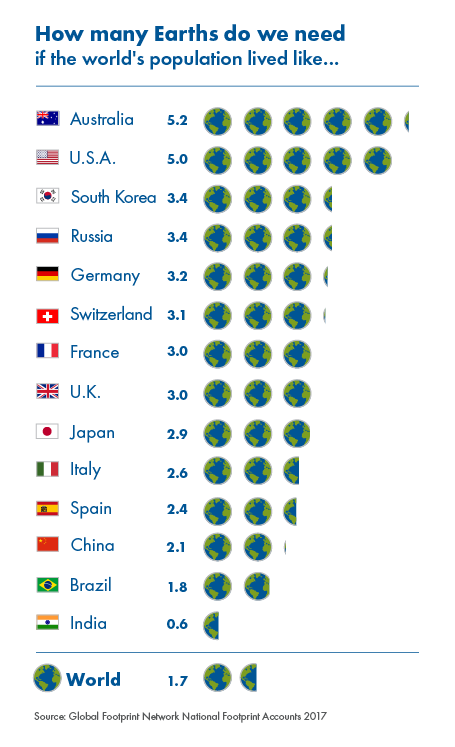
It happens that we are in Jersey taking the first steps in developing indicator metrics like the footprint above. That's the ongoing Future Jersey exercise. Imagine 2035 purported to do something similar a decade ago. That fiasco tried to engineer support for one of a pre selection of growth policy ambitions and completely and ignored future impacts like climate change. This current project has some hope of working. The wide ranging questionnaire and topics at the outset of course means we have at the raw data level a set of incoherent ambitions. Resolving those tensions and conflicts is where the real work happens.
It was a great pity that the IJCI report was delayed and therefore couldn't really feed into this Future Jersey activity more fully. It certainly touches on some relevant points . One area the survey suggested was very good in Jersey was being or feeling safe. Yet the evidence given to the Care Inquiry and one of its key conclusions arising is that children in the care system in Jersey continue to be put at risk.
Comments were also made by the ICJI report on decision making, politics and structures in Jersey. Eg form the executive summary " (x) Failure to tackle a silo mentality among public-sector agencies. States departments and institutions have been characterised by territorialism and protectiveness rather than openness to pooling resources and learning. As a result, there has been a lack of a comprehensive strategy to secure the bests interests of children in the island." Such behaviour and mentality is very unlikely to work when tackling holistic concerns and policies.
I think the work of Future Jersey gives a chance to begin unpicking that silo mentality and get to a position of better decision making and cooperative working across States departments. Intriguingly this opportunity arises from what many would probably see as the biggest weakness of the whole Future Jersey project - it doesn't change anything! And that criticism is largely true.
What we should have when all fifty plus of the indicators in the report are developed is a set of metrics to serve as a decision support tool. Every strategy and report could then be assessed against the metrics to see its impact and ensure aspects outside of the immediate expected consequences are considered. In theory we then get better decisions.
Quite what mechanics will be deployed to achieve hasn't been described. We already have a requirement in States propositions to complete a statement of manpower and financial implications. Having a statement of all fifty indicators might be to cumbersome, but it would put the factors up front in proposals. An alternative would be to have scrutiny review against the criteria. There are a few concerns here as scrutiny panels are segregated by area of interest and wouldn't necessarily have knowledge across all the factors. Also scrutiny do not call in all propositions for scrutiny, and occasionally policies don't even get to scrutiny or even the the States assembly (eg the current Rural economy strategy). As a third option we could have someone independent - equivalent of the Comptroller and Auditor general using the metrics to review , but that would certainly be retrospective, missing the main benefit of informing debate in the chamber.
However it comes into being we desperately need a mechanism for reviewing policies and actions in the round. These decisions are hard, sometimes very hard. I think about the impacts of my actions a lot , but I still find it hard to get to an acceptable sustainable position in my own life. I've sometimes been called a zealot or idealist trying to align what I believe is necessary with how I do things. But even with my 'extreme' decisions, even my footprint doesn't quite get to the necessary 1 planet level.

You can get a footprint for yourself at http://www.footprintcalculator.org/#!/
The Future Jersey report is at FUTURE JERSEY
Sunday, 1 January 2017
Peace on Earth, goodwill to all and a happy New Year.

You might be forgiven reading much of the press for thinking the traditional seasonal sentiment for this time of year is something of a sarcastic parody of what passed in 2016. It has even spawned headlines like Is 2016 the worst year in history ? But that would be a mistake I think.
Yes there have been conflicts and tensions in Syria, West Papua, and the Ukraine to name a few of the top of my head. We have seen relations between the USA and Russia and the USA and China more strained than for decades. So bad in fact the much respected journalist John Pilger described it as the third world war already under way.
On the other side of the argument we have seen a half century long armed conflict in Colombia end , and there are several studies showing the recent trend in deaths in wars is declining.

Unfortunately battle deaths are not the only casualties in war. For 2012, the first and latest year for which its estimates are available, the Center for Research on the Epidemiology of Disasters (CRED) estimates that more than 172 million people were affected by conflict worldwide. Of this total 149 million or 87 percent were conflict-affected residents (CARs). Internally displaced persons (IDPs) accounted for another 18 million and refugees for five million.
That preceding paragraph comes from 2016 World Hunger and Poverty Facts and Statistics
From here we also learn that hunger /undernourishment has decreased notable in both absolute and relative terms over the last 25 years.

The same paper also comments on one other significant question:
"Does the world produce enough food to feed everyone?
That last sentence is quite a problem. Bearing in mind that food is perishable and there is really only so many calories one can eat without producing ill effects, you have to wonder at both the logic and inhumanity of this. Where do all the surplus calories/food go? Either to waste or to producing unhealthy body weight.
So what of the other part of that sentence - the income bit ? Certainly over the last 2 centuries it seems things have improved overall.
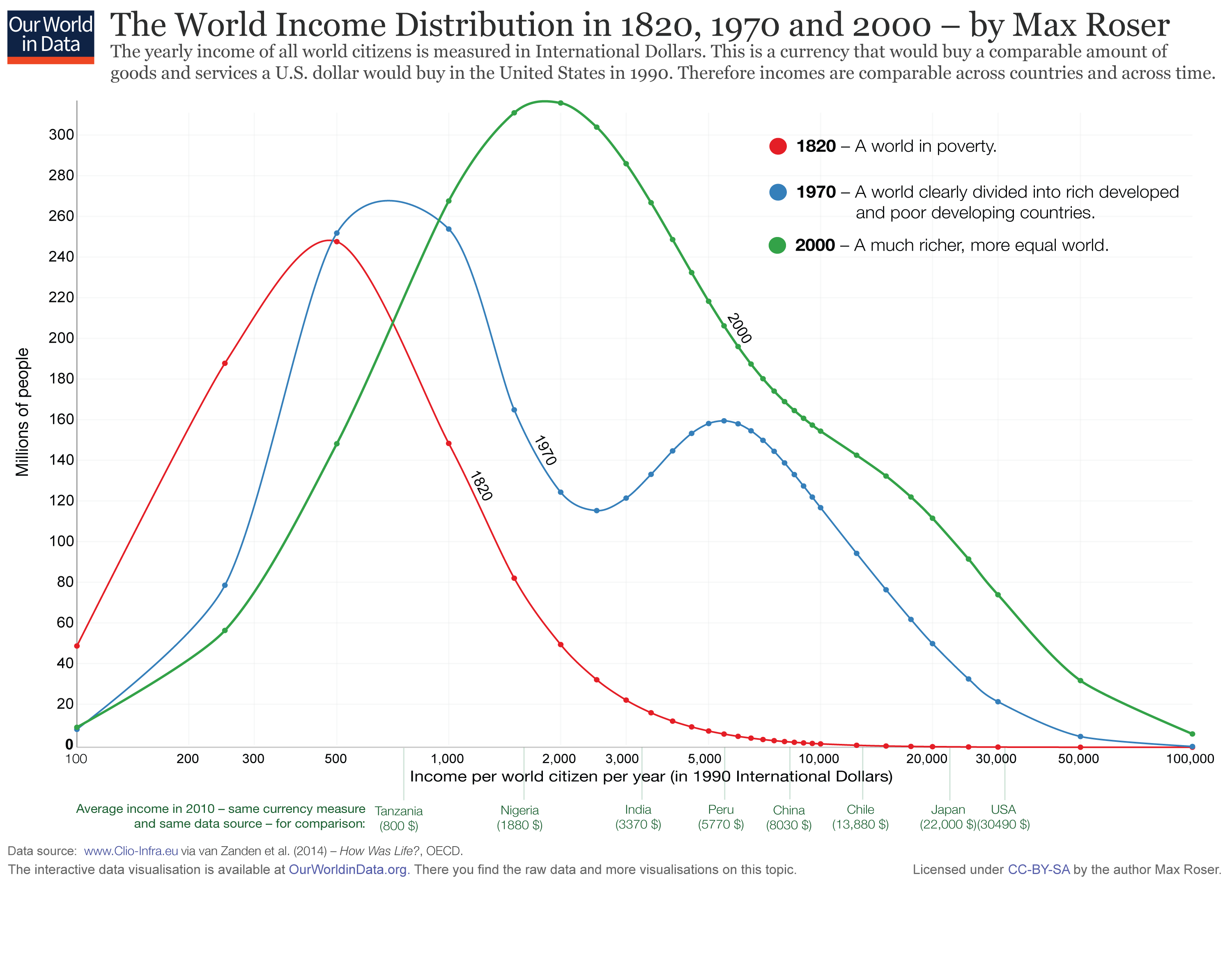
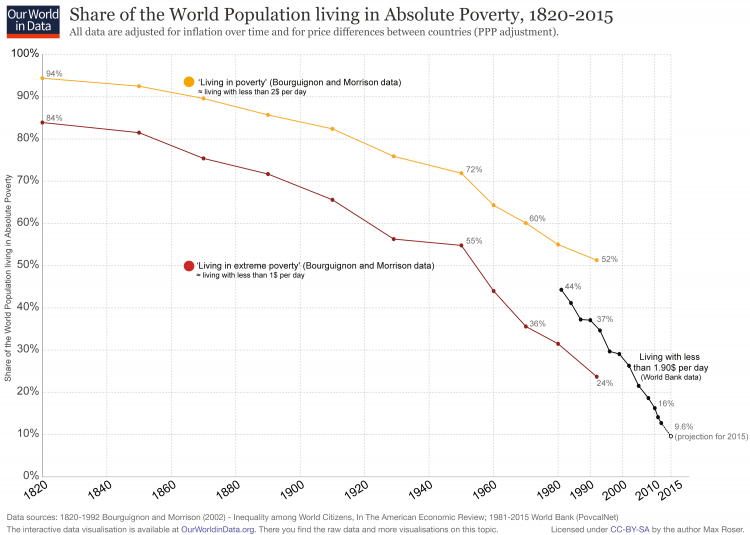
So from the purely economic and anthropocentric long terms view things are getting better. There may be hiccoughs and delays but slow improvements are happening. Who you might wonder is paying for this marvel of continuous improvement?
Try this from our Earth biodiversity
Just to illustrate the degree of biodiversity loss we're facing, let’s take you through one scientific analysis...
- The rapid loss of species we are seeing today is estimated by experts to be between 1,000 and 10,000 times higher than the natural extinction rate.
- These experts calculate that between 0.01 and 0.1% of all species will become extinct each year.
- If the low estimate of the number of species out there is true - i.e. that there are around 2 million different species on our planet - then that means between 200 and 2,000 extinctions occur every year.
- But if the upper estimate of species numbers is true - that there are 100 million different species co-existing with us on our planet - then between 10,000 and 100,000 species are becoming extinct each year.
In a generalised form, here is a graph of the dates of Earth overshoot day. That's the day each year where statistically we consume and pollute more than we believe the Earth can accommodate.

(In 2016 Earth overshoot day was August 8th).
It isn't Trump or Brexit or any of those things from 2016 that really worries me. It is the clear long term trend in this graph that is the real problem. Good will to all men (& women) isn't enough , not nearly enough. Nor is fear that leads to inward looking isolationism. The antidote to fear is gratitude. Consume less, share more. Be grateful to live in times where we have ample resource like food enough to feed everyone if we desire to. Be thankful we have medicine and technology to improve lives. Something has to change. The smart move it so change ourselves to avert the worst that might be imposed upon us. The window of opportunity may be short lived , I cannot tell, but appreciate you do have the opportunity to make a difference like no other generation so far has.
Thursday, 12 February 2015
Priorities
I have tried a number
of times to compose a response to the Council of Ministers'
proposed priorities 2015-18 document. It has been challenging not
least because the document makes absolutely no sense to me. Which is a great pity as I broadly
agree at least two of the four priorities ought to be
objectives for the life of this elected States. So instead of a structured posting I'm going to post some observations and see if someone elese can make a coherent formulation of either the Ministers' priorities or my notes.
I'll start at the
beginning – the contents page. Now you know things are bad when
even the contents page causes a problem. We have three sections
presented - setting the scene, then developing the priorities,
followed by creating a sustainable future. The first two seem
sensible, but the third does not flow or follow. The largest part
of the section has nothing to say about the future, it spends much of
its wording giving justification for the selection of the four
priorities. But crucially a sustainable future is NOT one of those
priorities. Why would you have a major heading of a section with a
title that is most definitely not what the document is not about?
Either it is grossly incompetent or there is a will to deceive the
casual reader of the real nature of the contents.
It is very confusing to
have page numbers the header of part of the document, but not all of
it. It makes referencing difficult as the on screen display does not
match the layout version.
On to the Introduction.
Nothing much there about the content, but why include a whole blank
page with just the word Introduction on it? A complete waste for
anyone who had decided to print the document.

Setting the scene. Now
things get 'interesting' . The report starts with a quote from the
OECD wellbeing report. What is said is true, but it is
simultaneously a half truth. The cherry picked bits are all the
positives.

Notice the areas where
we scored particularly badly both relatively and absolutely - civic
engagement and environmental quality - do not figure in the Council of Minsiters' priorities.
At the foot of the page
we have a statement “Over the next
20 years the number of people over-65 will double and there will be
nearly three times as many people over-85. Fewer people working,
fewer people paying tax, more demands on our health and pension
systems. This is unsustainable.” The
first sentence is probably true, but I note there are reasons to
think life expectancy here is declining
see 1
.The second
sentence is almost certainly false. People do not stop being tax
payers at 65 or 85 years old. Since the introduction of GST it is
almost certain that everyone resident in the Island pays some tax - one of the great 'benefits' claimed by the proponents when it
was introduced.
The
details on page 8 are inconsistent. On the third paragraph it reads
To enable us to meet this
financial challenge, we need to drive productivity-led economic growth". By the 7th
paragraph this imperative had transformed into "Economic
growth and public sector productivity are our preferred options to
meet the financial challenges we face”. We
do not need to do something if it is a specific form of an option.
There seems to be some very woolly thinking, or is it simply mantra
regurgitation occurring here?
Health
and wellbeing is covered on page 9 (or is it 8?), and there are some laudable aims
here. But again we have a sentence that causes great concern. At the
end of paragraph 4 we read "Declining
health leads
to social exclusion, loss of earnings, and adverse consequences in
the wider economy." But
in the section quoted here two paragraphs above we were led to think that
it was the ageing population that was creating a health demand
problem. Retired people do not in general lose earnings being ill
because in general they are not working and so not earning in the
first place. Again there seems to be some fundamental inconsistency
in the minds of the ministers here.
Page
12 is the education section. Saying I have misgivings about the
thrust of this section would be an understatement. More than once
this section suggests that the purpose of education is to mould
children and youths into supporting the economy. It is quite
disgraceful to write "The fact
that some of our children are not fulfilling their true potential is
a waste of Jersey’s
most
precious resource – our people - and an economic inefficiency we
can ill afford” This
notion that people exist and are valued only by the extent they make
an economic contribution is outrageous. I don't believe I have seen
such an unspeakably illiberal suggestion since a former Home Affairs
Minister said he wanted more political control of the police force.
There
is a practical problem with the proposal "Jersey’s
education system is aligned to, and supports,
the Island’s economic needs” It
takes a decade or more to educate and train someone . We have
little idea what will be the economic need in ten years time.
Several members of the Council of Ministers were in the States a
decade ago . How many of them then were arguing bringing
propositions etc for IT education to train a generation for today's
digital economy?
A
remark must be made about the quote in this section: "Education is the
most powerful weapon you can use to change the world". I think this is
quite inappropriate to use here. Madiba first gave that quote on his
visit to Boston in 1990 , just months after his release from prison.
He was not talking about education his people for taking jobs in the
white controlled economy of the day – he had supported campaign
for divestment from South Africa! He was talking about the sort of
change of world that the OECD has us scored as 0 in the the wellbeing
report cited above.
Economic growth is the
final priority, addressed on page 13. I cannot recall a time when
the States of Jersey didn't have economic growth as a priority. It
seems we just cannot get enough of it. This time round we have a new
twist. This is not ordinary economic growth this is Council of
Ministers' sustainable productivity-led economic growth.
In theory one can
achieve a long running period of economic growth from efficiency
improvements without any increase in material consumption or
pollution or population growth. It is extraordinarily hard however
as countless governments around the world have discovered when they
have tried it. There is a rapidly diminishing return on the effort
involved. It would require a society of less work and increasing
low energy, low consumption leisure activity. That goes against
several generations of belief that increased material and financial
acquisition is the way to a better future. And therein lies the
problem.
If the policy succeeds
we have more people on average with more disposable income, and more
tax revenue for the States presumably, but equally the potential to
consume even more than now. That's not a good outcome in the face of
resource limits, climate change and the ecology of the Island. But
what if educated, well trained people are not motivated to have more
money. Also there is nothing to suggest we would tackle the
increasing inequality in income and wealth that would be expected
produce. Then the policy fails as more and more comfortably off
people effectively downshift work and lives at ever earlier ages.
Even if that were the
intention it is quite unclear if it might be manageable. The current
global economic conditions are quite unlike any in the lifetime of
any of our currently elected politicians out side perhaps of Japan.
Half decade lows in prices of gold, oil, iron ore, copper, corn and
interest rates point clearly to a deflationary environment. Growth
of any sort under such circumstances is a rare thing. The
goldilocks economics proposed by the Council of Ministers works the
other way round – the productivity gains eg from new technology,
produces price deflation (and increased consumption). We have it the
other way round – a sequence more likely to lead to recession. The
more likely outcome is lower costs, lower wages and an even lower tax
revenue for the States. What is suggested is a step closer to what
is needed than any previous growth ambitions of the States. It is
still some way however from the steady state economy2 that
I would advocate.
Of course I have again
to comment on the quote. “Someone's sitting in the shade of a tree
today because someone planted a tree a long time ago”. Warren
Buffet . You might think that in an Island so dependent on the
finance industry they would have got right the spelling of the name
of probably the world's most famous living investor -Warren Buffett.
If you cannot get such an easily checked detail right .........
Of course Mr Buffett was referring to investing
for the long term (smart man - he's right too on that aspect).
However there is also a deep fallacy in that quote. It is not the
case that all trees are planted by someone. Who do you think planted
the Amazon, or the taiga, or the great rainforests of Africa? Trees
for the most part are self seeded, they are the bounty of nature.
When you start thinking that a tree can only be because someone
planted it, you are in danger of thinking all that is of value is
that which humans create. It also underlines a critical point so
often overlooked in economics. It is nature who provides 'free
services' like trees and pollinators and rain without which we would
have no economy. We cannot have a sustainable economy, let alone
growth, unless we have a sustainable underpinning foundation – the
ecosystem services. As our species consumes and pollutes
increasingly beyond the capacity of the planet 3 , as it
has done since the 1970's, we get further and further from that
possibility.
3/
http://unearthnews.org/2013/10/01/earth-overshoot-day-how-can-we-reduce-our-ecological-footprint/
Subscribe to:
Posts (Atom)